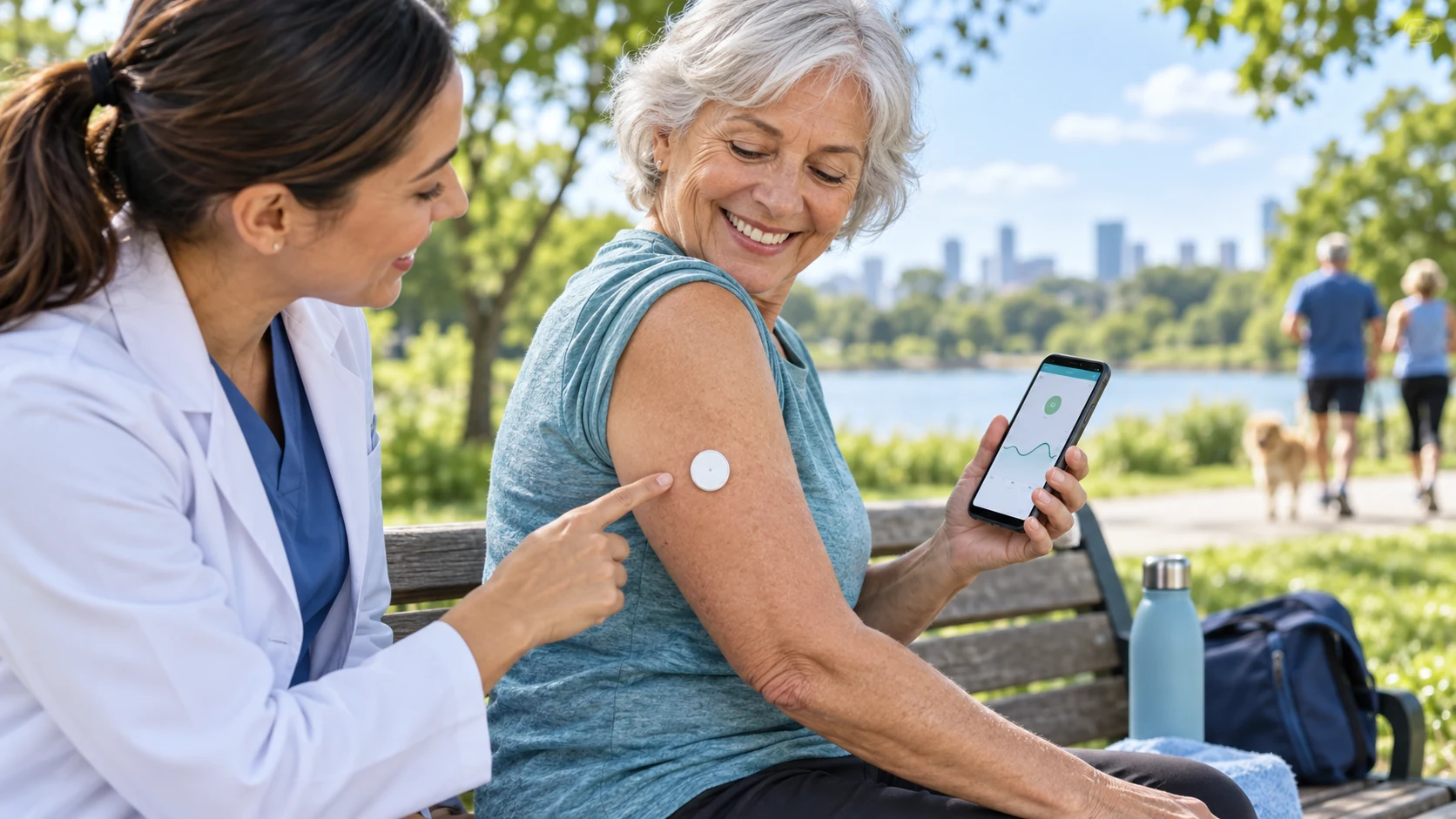
For the millions of Americans living with diabetes, knowing your blood glucose level at any given moment used to mean pricking your finger, applying blood to a test strip, and waiting for a reading. A continuous glucose monitor (CGM) changes that completely — delivering automatic readings every few minutes, around the clock, often directly to your smartphone.
In 2026, Medicare covers CGMs for qualifying beneficiaries, and these devices have become a cornerstone of modern diabetes management for people of all ages.
What Is a CGM?
A continuous glucose monitor is a small wearable medical device with three main components:
- Sensor — a tiny filament inserted just beneath the skin (usually on the arm or abdomen) that continuously measures glucose levels in the interstitial fluid. Sensors typically last 10–15 days before replacement.
- Transmitter — a small device attached to the sensor that sends glucose readings wirelessly
- Receiver/Display — a dedicated receiver device, smartphone app, or smartwatch that shows your current glucose level, trend arrows (rising, falling, or stable), and alerts
CGMs measure glucose every 1–5 minutes and provide far more information than traditional finger-stick meters. They show not just where your glucose is right now, but where it's heading — which is often more valuable for making decisions about food, exercise, and insulin.
What CGMs Do That Meters Can't
| Feature | Traditional Meter | CGM |
|---|---|---|
| Glucose reading | Single point-in-time result | Continuous, every 1–5 minutes |
| Trend data | No | Yes — shows if glucose is rising or falling |
| Alerts for highs/lows | No | Yes — customizable alarms |
| Overnight monitoring | Requires waking up | Automatic — alerts even while sleeping |
| Finger sticks | Required every reading | Usually none (some still require calibration) |
| Sharing with others | No | Yes — caregivers/family can monitor remotely |
| Data reports | Limited | Detailed time-in-range reports for provider review |
Major CGM Devices in 2026
Several CGM systems are widely used and Medicare-covered in 2026:
- Dexcom G7 — all-in-one sensor/transmitter, worn on upper arm or abdomen, 10-day wear, no finger-stick calibration required, app-based display with Apple Watch integration
- Abbott FreeStyle Libre 3 — small coin-sized sensor worn on upper arm, 14-day wear, continuous real-time readings via app, alarms for highs and lows, highly popular for its discreet profile
- Medtronic Guardian 4 — designed to integrate with Medtronic insulin pumps for automated insulin delivery; sensor worn on abdomen
- Stelo by Dexcom — OTC biosensor for non-insulin-using Type 2 patients; does not require prescription
Health Benefits of CGM Use
Research consistently shows that CGM use improves diabetes management outcomes:
- Lower A1C — multiple clinical trials show A1C reductions of 0.5–1.0% or more in CGM users vs. finger-stick monitoring alone
- More time in range — CGM users spend more time with glucose in the 70–180 mg/dL target range
- Fewer dangerous lows — nighttime alerts help prevent severe hypoglycemia, which can be life-threatening
- Better treatment decisions — trend arrows and alarms allow more proactive management before glucose gets too high or too low
- Reduced diabetes distress — many users report feeling less anxious about their glucose because they can see it and respond in real time
CGM Coverage Under Medicare
Medicare Part B covers CGMs as therapeutic continuous glucose monitors (durable medical equipment) when:
- You have diabetes mellitus
- You are treated with insulin OR your provider documents that CGM is medically necessary for your diabetes management
- Your doctor provides a written order (prescription) for the CGM
- You obtain the device from a Medicare-enrolled DME supplier
Medicare coverage includes both the CGM device itself and the ongoing sensors and supplies. Under Part B, you typically pay 20% of the Medicare-approved cost after the Part B deductible ($257 in 2026). With a Medicare Advantage plan, cost-sharing may be lower.
Getting Started with a CGM
- Talk to your doctor — ask if a CGM is appropriate for your diabetes management and request a prescription
- Choose a device — your doctor or a diabetes educator can help match you to the right system based on your insulin regimen, lifestyle, and insurance
- Order from a Medicare-enrolled supplier — the supplier will handle prior authorization and billing
- Get training — your doctor's office, a diabetes educator, or the device manufacturer's support line can walk you through setup and use
- Share data with your provider — CGM apps generate detailed reports that your endocrinologist or primary care doctor can review at appointments to fine-tune your treatment plan
Want to find a Medicare Advantage plan with strong diabetes benefit coverage including CGMs and other DME? Talk to a licensed advisor — free, no obligation.
Call 1-866-340-3441Frequently Asked Questions
Do I still need to do finger sticks with a CGM?
Most modern CGMs do not require routine finger-stick calibration. However, some situations — like when you feel symptoms that don't match your CGM reading, or when making a critical dosing decision — may warrant a confirmatory finger stick. Your specific device's guidance will explain when confirmation is recommended.
How accurate are CGMs?
Modern CGMs are highly accurate for most clinical purposes, though they measure glucose in interstitial fluid (which lags blood glucose by 5–15 minutes during rapid changes). For most day-to-day management decisions, this difference is not clinically significant. The FDA evaluates CGM accuracy under its 510(k) clearance process.
Can I wear a CGM in the shower or pool?
Yes. Most current CGMs are water-resistant to at least 30 minutes at a specified depth. Some are rated for swimming. Check your specific device's waterproofing rating before extended water exposure.